
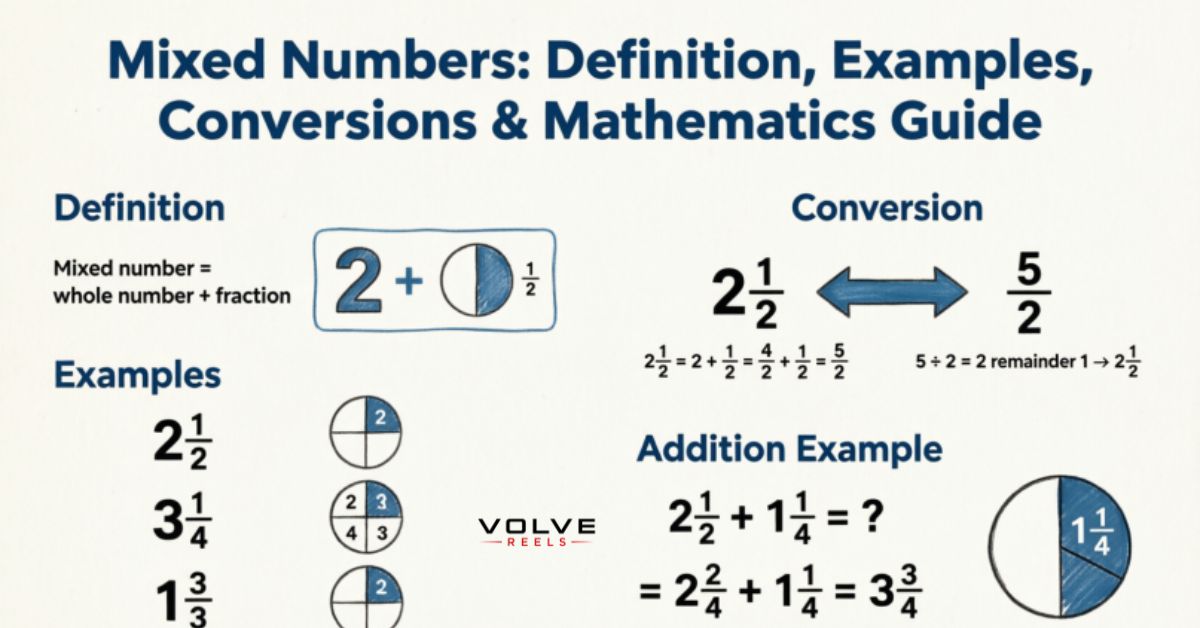

Mixed numbers are an important part of elementary mathematics because they provide a simple way to represent quantities greater than one. A mixed number contains a whole number and a proper fraction, such as 2 ½ or 4 ¾. Learning the definition of a mixed number helps students understand how whole quantities and fractional parts work together. You may also come across questions such as what are mixed numbers, how to convert them, or how they relate to improper fractions.
These concepts become much easier when you connect them with real-life examples, visual models, and simple calculations. For instance, 3 ¼ cups means three complete cups plus one-quarter of another cup. In this guide, we’ll explore mixed numbers in mathematics, explain their relationship with improper fractions, and provide practical examples. You’ll also learn how to convert a mixed number to improper fraction form and recognize these values confidently.
Understanding Mixed Numbers In Mathematics
The definition of a mixed number is a number that combines a whole number with a proper fraction. In simple terms, it is a number made up of a whole number and a fraction. The whole number represents complete units, while the fraction represents an additional part of one more unit.
For example, 3 ½ is a mixed number. The 3 tells us that there are three complete wholes, while ½ represents half of another whole. Similarly, 5 ⅓ means five complete units and one-third of another unit.
Understanding what are mixed numbers becomes easier when you think about everyday quantities. Imagine you have three whole pizzas and half of another pizza. Instead of describing the amount only as an improper fraction, you can simply say that you have 3 ½ pizzas.
A mixed number normally contains three important elements:
Whole number: The complete units in the quantity.
Numerator: The top number of the fraction, showing how many fractional parts are being used.
Denominator: The bottom number, showing how many equal parts make one whole.
For example, in 4 ⅗, 4 is the whole number, 3 is the numerator, and 5 is the denominator.
Mixed numbers are especially useful for measurements. A length of 6 ¾ inches, a weight of 2 ½ pounds, or a recipe requiring 1 ⅓ cups can all be written naturally using mixed numbers. They allow mathematical values to be understood quickly without losing the fractional detail.
Read More: Mixed Numbers: Definition, Examples, Conversions & Mathematics Guide
Mixed Numbers And Improper Fractions
Mixed numbers and improper fractions represent the same mathematical values, but they display those values differently. A mixed number separates the whole units from the fractional part, while an improper fraction expresses the entire quantity as one fraction.
Consider 9/4. Since four-fourths equal one whole, eight-fourths equal two wholes. One-fourth remains. Therefore:
9/4 = 2 ¼
Here, 9/4 is the improper fraction and 2 ¼ is the mixed number.
An improper fraction has a numerator that is greater than or equal to its denominator. A mixed number, on the other hand, shows the whole-number portion separately from a proper fraction.This connection is important because students often need to move between the two forms. For example:
2 ⅔ = 8/3
Mixed numbers can be easier to understand in practical situations. If someone says they walked 4 ½ miles, the quantity is immediately clear. The equivalent improper fraction, 9/2 miles, is mathematically correct but may not be as intuitive.
However, improper fractions can be more convenient during calculations. When multiplying or dividing fractions, converting a mixed number into an improper fraction often makes the calculation more straightforward.Understanding the relationship between these forms also improves fraction sense, estimation, comparison, and problem-solving skills.
Mixed number example
A simple mixed number example is 2 ¾. This value contains two complete wholes and three-fourths of another whole.
Here are several examples:
1 ½ = one whole and one-half
2 ⅓ = two wholes and one-third
3 ⅝ = three wholes and five-eighths
5 ¼ = five wholes and one-quarter
7 ⅚ = seven wholes and five-sixths
Each example follows the same basic structure: a whole number followed by a proper fraction.
Imagine a wooden board that measures 4 ½ feet. You have four complete feet plus another half-foot. The same quantity could be written as 9/2 feet, but the mixed-number form makes the measurement easier to visualize.
Another example is 2 ⅓ hours. This means two complete hours plus one-third of an hour. Since one-third of an hour is 20 minutes, the quantity equals 2 hours and 20 minutes.These everyday examples show why mixed numbers are more than a classroom concept. They appear naturally when quantities don’t fall exactly on whole numbers.
Mixed numbers in mathematics worksheet

A Mixed numbers in mathematics worksheet can give students structured practice with identifying, converting, comparing, and calculating mixed numbers. A well-designed worksheet usually begins with basic recognition before moving toward more advanced fraction operations.
For example, an introductory exercise might ask students to identify the whole number and fractional part in 6 ⅖. A second activity could ask them to convert 3 ½ into an improper fraction.
Students may also solve questions such as:
Convert 4 ⅓ to an improper fraction.
Answer: 13/3
Or:
Convert 17/5 to a mixed number.
Answer: 3 ⅖
More advanced worksheets can include addition, subtraction, multiplication, and division with mixed numbers. Word problems can make these exercises even more meaningful.
For example, a student might be asked how much ribbon remains after using 2 ¼ meters from a roll containing 5 ½ meters.
Worksheet practice is valuable because repetition helps students recognize patterns. Instead of memorizing isolated rules, they begin to understand how whole numbers, numerators, denominators, improper fractions, and mixed numbers are connected.
Mixed numbers in mathematics examples
Mixed numbers in mathematics examples can help learners connect fraction notation with practical quantities.Suppose a baker needs 3 ½ cups of flour. This means three complete cups plus half of another cup. The same quantity can be expressed as 7/2 cups.
Consider another situation where a runner completes 5 ¾ miles. The runner has covered five complete miles and three-quarters of another mile.Mixed numbers also work with money, measurements, distance, weight, and time. A package weighing 2 ½ kilograms contains two complete kilograms plus half a kilogram.
Here are a few useful examples:
3 ¼ = 13/4
4 ½ = 9/2
6 ⅔ = 20/3
7 ⅕ = 36/5
8 ¾ = 35/4
These examples demonstrate that every mixed number can be represented as an equivalent improper fraction.
The key is to understand the meaning rather than simply memorize the notation. Once students see that each fractional part represents a portion of another whole, the concept becomes much easier.
Mixed number to improper fraction
Learning how to change a mixed number to improper fraction form is an essential fraction skill. The process uses three simple steps.
Take the mixed number 3 ⅖.
First, multiply the whole number by the denominator:
3 × 5 = 15
Next, add the numerator:
15 + 2 = 17
Finally, keep the original denominator:
3 ⅖ = 17/5
The general rule is:
(Whole number × Denominator) + Numerator = New Numerator
The denominator remains unchanged.
Let’s try another example:
6 ¾
Multiply:
6 × 4 = 24
Add the numerator:
24 + 3 = 27
Therefore:
6 ¾ = 27/4
This method works because the whole-number portion must first be expressed using the same fractional unit. Six wholes equal 24 fourths, and adding three more fourths gives 27/4.
The reverse process is also useful. To convert an improper fraction into a mixed number, divide the numerator by the denominator.
For example:
19/4
19 ÷ 4 gives a quotient of 4 with a remainder of 3.
Therefore:
19/4 = 4 ¾
Understanding both conversions gives students flexibility when solving fraction problems.
What is a mixed number in fractions
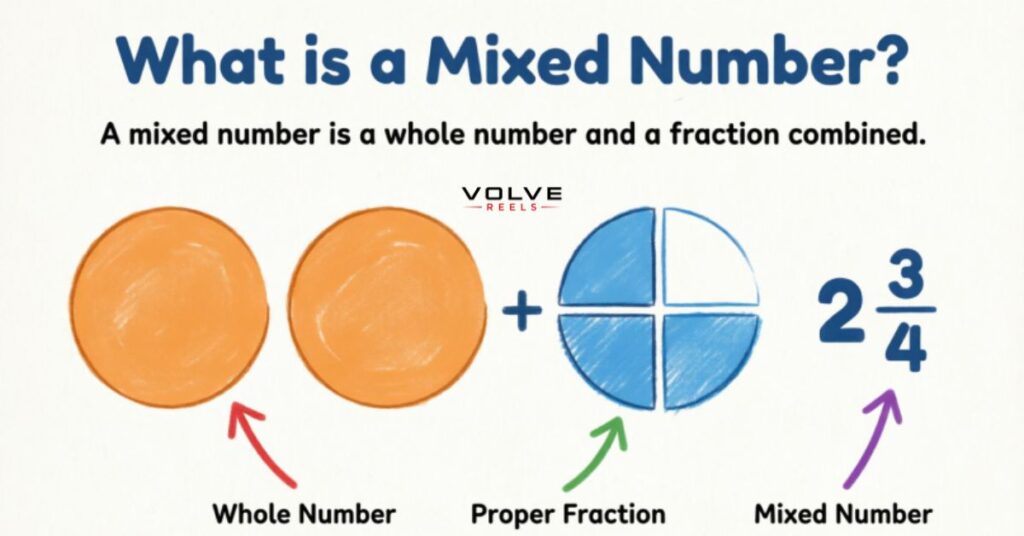
What is a mixed number in fractions? A mixed number is a way of writing a value that contains at least one whole unit and an additional fractional amount.For example, 5 ⅔ means five complete wholes and two-thirds of another whole.
The fraction portion must normally be a proper fraction, meaning the numerator is smaller than the denominator. In 5 ⅔, the numerator is 2 and the denominator is 3.Mixed numbers are often used instead of improper fractions because they can make quantities easier to read and interpret. Saying 7 ½ feet gives an immediate picture of seven full feet plus half of another foot.
The same value can be written as:
7 ½ = 15/2
The two forms are equivalent. The choice between them depends on the context. Mixed numbers are often convenient for measurements and explanations, while improper fractions can simplify certain mathematical calculations.
Using Models To Teach Mixed Numbers
Using visual models can make mixed numbers much easier for students to understand. Instead of seeing a mixed number as two separate symbols, learners can see how the whole and fractional parts combine to create one quantity.A teacher might use circles divided into equal sections. To represent 2 ¼, students can shade two complete circles and one-quarter of a third circle.
This visual model immediately shows that the number contains two wholes and one fractional part.Rectangles and fraction bars can work in the same way. If each rectangle represents one whole, three complete rectangles plus two-thirds of another rectangle represent 3 ⅔.
Number lines are another powerful model. Divide the space between whole numbers into equal sections according to the denominator. For example, to locate 2 ¾, divide the interval between 2 and 3 into four equal parts. The third mark after 2 represents 2 ¾.
These models build a stronger understanding of fractions because students can see where the value belongs and how it relates to nearby whole numbers.
Mixed Numbers Using Fraction Strips
Fraction strips provide a hands-on method for learning mixed numbers. Each complete strip can represent one whole, while smaller sections represent fractional parts.To model 2 ⅔, place two complete strips together. Then take another strip divided into three equal sections and use two of those sections. The complete display represents 2 ⅔.
Fraction strips can also demonstrate why 2 ⅔ = 8/3. If each whole contains three thirds, then two wholes contain six thirds. Adding two more thirds produces eight thirds:
3/3 + 3/3 + 2/3 = 8/3
This makes the conversion from a mixed number to an improper fraction much more meaningful. Students aren’t simply following a formula; they’re seeing why the formula works.Fraction strips can also help learners compare values. For example, placing 1 ½ and 1 ¾ side by side makes it obvious that 1 ¾ is larger.
Mixed Number Illustrations

Mixed number illustrations can include fraction circles, shaded rectangles, bar models, and number lines. These visuals help students understand the relationship between complete units and fractional pieces.
For example, 3 ½ can be represented using three fully shaded circles and one-half of another circle. A number line can show the same value as the point halfway between 3 and 4.
Illustrations are especially useful for younger learners because they turn an abstract mathematical expression into something visible. They also help students develop estimation skills and recognize whether an answer makes sense.
Mixed number examples with answers
Here are some mixed number examples with answers for quick practice:
Example 1: Convert 2 ½ to an improper fraction.
Answer: 5/2
Example 2: Convert 13/4 to a mixed number.
Answer: 3 ¼
Example 3: Convert 5 ⅔ to an improper fraction.
Answer: 17/3
Example 4: Convert 22/5 to a mixed number.
Answer: 4 ⅖
Example 5: Add 1 ½ + 2 ¼.
Answer: 3 ¾
These problems reinforce both conversion and basic fraction operations.
5 examples of mixed fraction
Here are 5 examples of mixed fraction values:
1 ½ — one whole and one-half
2 ⅓ — two wholes and one-third
3 ¾ — three wholes and three-fourths
4 ⅖ — four wholes and two-fifths
6 ⅞ — six wholes and seven-eighths
The term mixed fraction is commonly used to describe the same mathematical form as a mixed number. In each case, the value contains a whole-number component and a proper fractional component.
Frequently Asked Questions
What is a mixed number in math?
A mixed number contains a whole number and a proper fraction, such as 4 ½. It represents four complete wholes plus one-half of another whole.
What are 5 examples of mixed numbers?
Five examples are 1 ½, 2 ⅓, 3 ¾, 5 ⅖, and 7 ⅛. Each combines a whole number with a proper fraction.
What is 21 ⁄ 4 as a mixed number?
Divide 21 by 4. The quotient is 5 and the remainder is 1, so 21/4 = 5 ¼.
How to calculate a mixed number?
To convert an improper fraction into a mixed number, divide the numerator by the denominator. The quotient becomes the whole number and the remainder becomes the numerator.
How do I convert a number to a mixed number?
For an improper fraction, divide the numerator by the denominator. For example, 14/3 = 4 ⅔, because 3 goes into 14 four times with 2 left over.
Conclusion
Mixed numbers make it easier to describe quantities that contain complete units and fractional parts. A value such as 4 ¾ immediately tells you that there are four wholes plus three-fourths of another whole. Understanding the definition of a mixed number also creates a strong foundation for learning improper fractions, equivalent values, and fraction operations. Throughout this guide, we’ve explored mixed numbers in mathematics, practical examples, visual models, fraction strips, and conversion methods.
You now know how to change a mixed number to improper fraction form and how to turn an improper fraction back into a mixed number. These skills are useful in classroom exercises as well as everyday measurements involving distance, weight, time, and quantities. Whether you’re answering a mathematics worksheet or solving a real-world problem, recognizing the relationship between the whole number and fractional part will make fractions much easier to understand, compare, calculate, and explain accurately.
Meta Description:
Learn what mixed numbers are, see examples, understand mixed numbers in mathematics, and discover easy ways to convert mixed numbers to improper fractions.

