
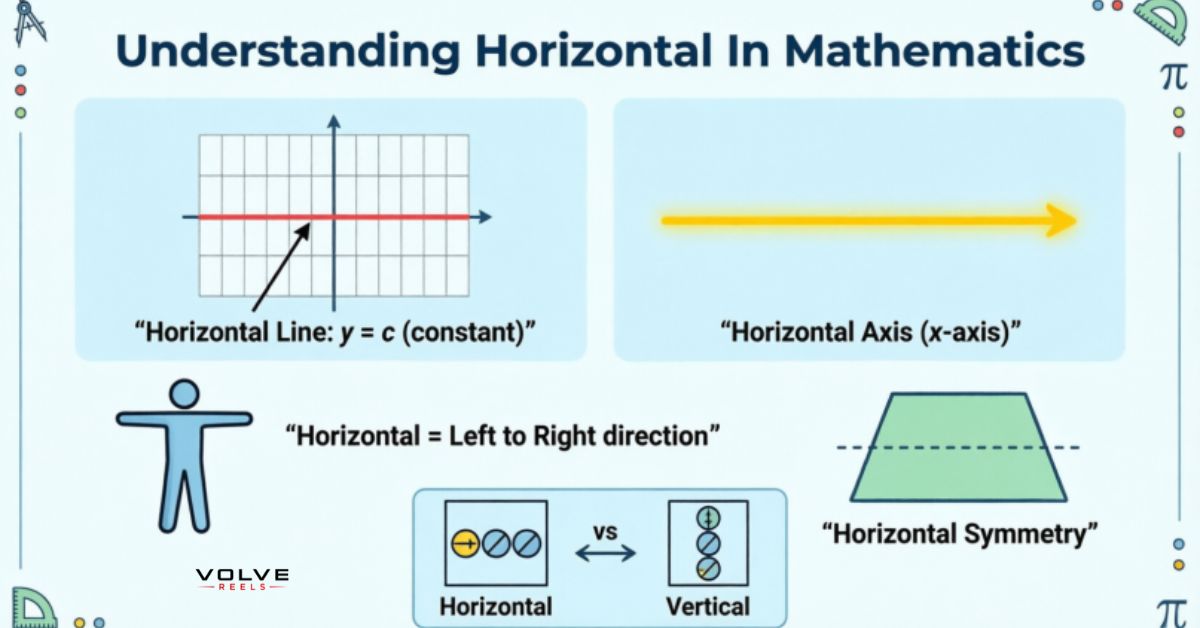

The word horizontal describes a direction that runs straight from left to right, flat and level, without tilting up or down. It’s one of the first spatial concepts young learners pick up, and it quietly supports much bigger ideas later on from reading a ruler to plotting points on a graph. Once a student can confidently spot what’s horizontal, they’re better equipped to classify lines, notice symmetry, measure width, and describe how objects sit in space, both on paper and in the real world around them.
This guide walks through what horizontal really means in math, how it connects to vertical direction, where it shows up in geometry and graphing, and practical ways teachers can help this concept click. You’ll also find real examples, everyday applications, and answers to common questions students ask about horizontal lines and orientation.
Why Understanding Horizontal Is Important
Understanding horizontal direction helps us describe the position and movement of objects accurately. It’s important in fields like mathematics, design, architecture, and everyday navigation.
Horizontal Describes Direction and Spatial Relationships
Grasping horizontal direction gives students a reliable way to talk about how things are positioned, arranged, or aligned in space. Rather than guessing at position with vague words, they gain a consistent term that applies across math and everyday life alike. In measurement, horizontal orientation comes into play whenever students compare width or read values along a ruler or number line.
In geometry, spotting horizontal lines helps students recognize alignment and symmetry within shapes. And outside the classroom, this same thinking helps kids interpret maps, follow diagrams, and describe familiar objects like tabletops, shelves, or the flat line of the horizon at sunset.
Horizontal in Geometry, Symmetry, and Graphing
In early geometry, the idea of horizontal helps students spot meaningful patterns across both shapes and data sets. When a figure shows horizontal symmetry, its top half mirrors its bottom half, divided by a line running left to right. Noticing this kind of balance sharpens how precisely students describe shapes, and it builds a foundation for later concepts like congruence and reflection.
Horizontal direction also shapes how students approach early graphing. Once coordinate grids enter the picture, students learn that the x-axis runs horizontally across the plane. This reinforces the idea that horizontal position tracks values increasing or decreasing from left to right, whether they’re plotting points, reading data, or spotting a trend.
Read More: SZN Meaning: Definition, Origin, and How People Use It
The Relationship Between Horizontal and Vertical
Horizontal and vertical sit at opposite ends of direction, and understanding both gives students sharper language for describing position, orientation, and shape. In math, these two directions form the backbone of axes, grids, and reference points used throughout geometry and graphing.
Recognizing how horizontal and vertical lines interact helps students understand ideas like perpendicularity, parallelism, and symmetry. This distinction also matters when comparing width against height horizontal describes how far something spreads sideways, while vertical describes how tall or elevated it stands.
Further along, these two directions become essential building blocks for graphing, since the horizontal x-axis and vertical y-axis together create the framework for plotting and reading data. Understanding how they interact lays groundwork for angles, slope, and spatial reasoning in more advanced math down the road.
Teaching Strategies for Horizontal
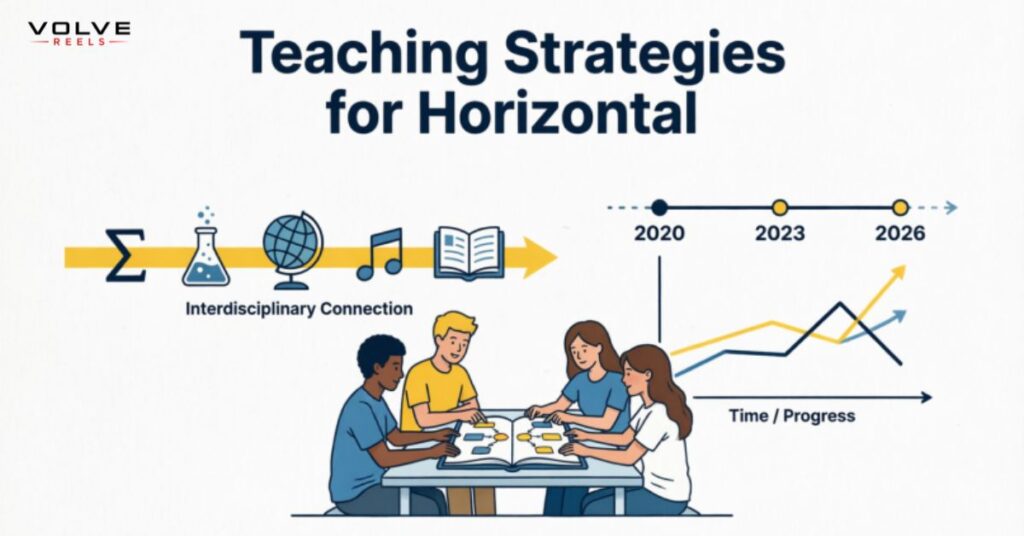
Teaching strategies for horizontal learning focus on collaboration, peer learning, and sharing ideas among students.
Teachers can use group discussions, teamwork, peer teaching, and interactive activities to help students learn from one another.
Exploring Horizontal Direction and Position
Students develop a natural feel for horizontal direction by observing, building, and reasoning about objects and movement around them.
Start with movement-based exploration. Ask students to stretch their arms straight out to each side, sweep a hand from left to right, or walk in a straight horizontal path across the room. This kind of physical grounding helps them connect the word “horizontal” to a consistent direction they can feel and repeat.
From there, run a horizontal scavenger hunt. Have students search the classroom for objects positioned horizontally tabletops, windowsills, shelves and compare these against vertically oriented objects like door frames or flagpoles. Prompt them with questions like, “How do you know this is horizontal?” or “What sets horizontal apart from vertical?”
To push the idea further, invite students to build horizontal structures using blocks, straws, or pipe cleaners. While constructing, ask them to explain which parts of their build are horizontal and how those parts differ from vertical or angled sections.
Horizontal Lines and Symmetry
Once students can spot horizontal orientation around them, they’re ready to represent it on paper and reason about properties like symmetry.
Give students a simple grid alongside a mix of line segments pointing in different directions. Have them highlight or color only the horizontal lines, then explain their reasoning: “How can you tell which lines are horizontal?” or “What do all horizontal lines share in common?”
To deepen the concept, ask students to sketch their own horizontal lines using familiar references a tabletop edge, the horizon, or a bookshelf.
Then move into symmetry. Show a mix of symmetrical and asymmetrical letters, numbers, and shapes, and have students decide which ones show a horizontal line of symmetry. Ask, “How do you know if a shape has horizontal symmetry?” and “What makes horizontal symmetry different from vertical symmetry?” Let students test their answers by folding paper or holding a mirror along the horizontal line.
Reasoning About Horizontal Direction
At this stage, students apply their understanding of horizontal direction to analyze patterns, reason through problems, and make predictions about shapes.
Present shapes on a grid and ask students to predict what they’ll look like once reflected across a horizontal axis. Have them sketch their prediction first, then check it by folding the shape or using a mirror. Ask: “What changed? What stayed the same? How does reflecting across a horizontal line differ from reflecting across a vertical one?”
Open-ended prompts work well here too: “Can you design your own figure with a horizontal line of symmetry? How did you make sure it worked?” or “If you draw a horizontal line through the middle of a rectangle, will you always get two equal halves? What about a triangle?” Encourage testing with physical shapes or drawings so students reason through how horizontal orientation shapes geometric properties, rather than simply identifying lines by sight.
Types of Horizontal in Mathematics
Horizontal shows up in a few distinct forms across math, each with its own role. A horizontal line is the most basic type, running flat from left to right with no slope, often represented by the equation y = c, where c stays constant no matter what x equals. A horizontal axis, commonly the x-axis on a coordinate grid, provides the reference line for plotting values sideways.
Horizontal symmetry refers to a shape whose top and bottom mirror each other across a horizontal fold line. Finally, horizontal alignment in measurement and geometry describes how objects or points line up evenly along the same flat plane. Recognizing these variations helps students apply the concept correctly depending on the context, whether it’s algebra, geometry, or data representation.
Horizontal in Mathematics Examples
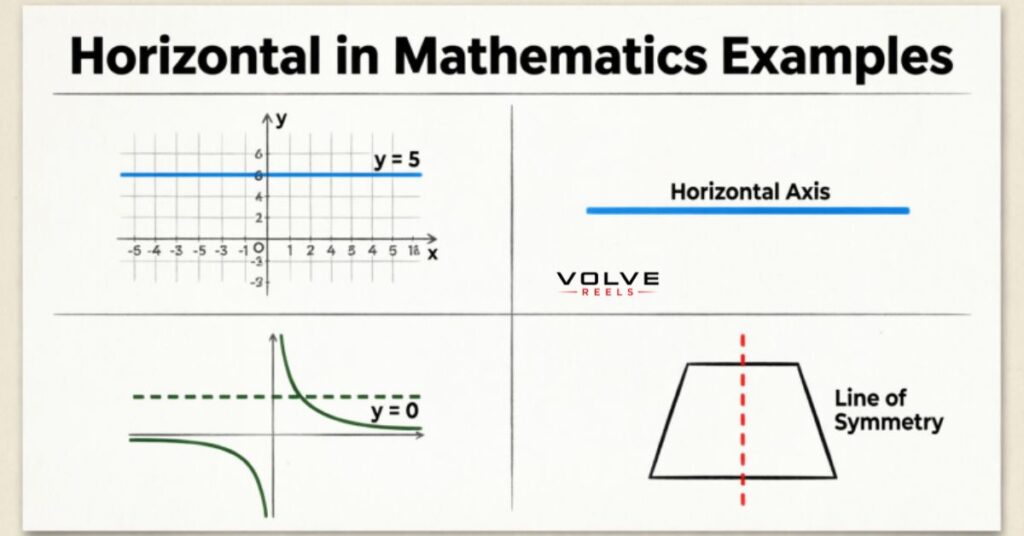
Concrete examples make horizontal concepts far easier to absorb than definitions alone. The equation y = 5 represents a horizontal line, since every point on it sits at the same height regardless of the x-value. A rectangle’s top and bottom edges are classic examples of horizontal sides, running parallel to each other. On a bar graph, the horizontal axis typically lists categories, while the vertical axis shows values. In symmetry problems, a shape like the letter “B” has a horizontal line of symmetry, since folding it along a middle horizontal line produces two matching halves. These examples span algebra, geometry, and data analysis, showing just how often horizontal thinking comes into play.
Vertical Line
A vertical line runs straight up and down, standing perpendicular to a horizontal line. In coordinate geometry, it’s represented by an equation like x = 3, where every point shares the same x-value no matter how far up or down it extends. Unlike horizontal lines, vertical lines have an undefined slope, since there’s no horizontal change to measure against the vertical rise.
Vertical lines commonly appear as the y-axis on a graph, as the sides of rectangles and squares, and in real-world structures like flagpoles, door frames, and building columns. Understanding vertical lines alongside horizontal ones gives students a complete picture of directional geometry.
Horizontal Line Y Axis
While the x-axis is horizontal, students sometimes wonder about a horizontal line drawn in relation to the y-axis. A horizontal line intersects the y-axis at exactly one point and runs parallel to the x-axis for its entire length. For example, the line y = 4 crosses the y-axis at the point (0, 4) and continues flat in both directions without ever touching the y-axis again. This relationship helps students understand that horizontal lines and the y-axis interact at a single fixed point, which becomes especially useful when graphing linear equations and analyzing intercepts.
Horizontal Line Represents
In graphing and algebra, a horizontal line represents a constant value that doesn’t change as the independent variable shifts. Because the y-value stays fixed while x varies freely, the line has a slope of zero. This makes horizontal lines useful for showing steady, unchanging quantities like a fixed price, a constant temperature, or a flat rate over time. In data visualization, a horizontal reference line often marks an average, target, or benchmark value, helping viewers quickly compare other data points against that constant.
Horizontal Shape
A horizontal shape refers to any figure that’s wider than it is tall, stretching more along the left-right direction than up and down. Rectangles, ovals, and parallelograms often appear in a horizontal orientation, especially when their length outweighs their height. Recognizing horizontal shapes helps students describe proportions accurately and supports later concepts like area, perimeter, and scale, where orientation can influence how a shape is measured or compared to others.
Horizontal Line Example in Real Life
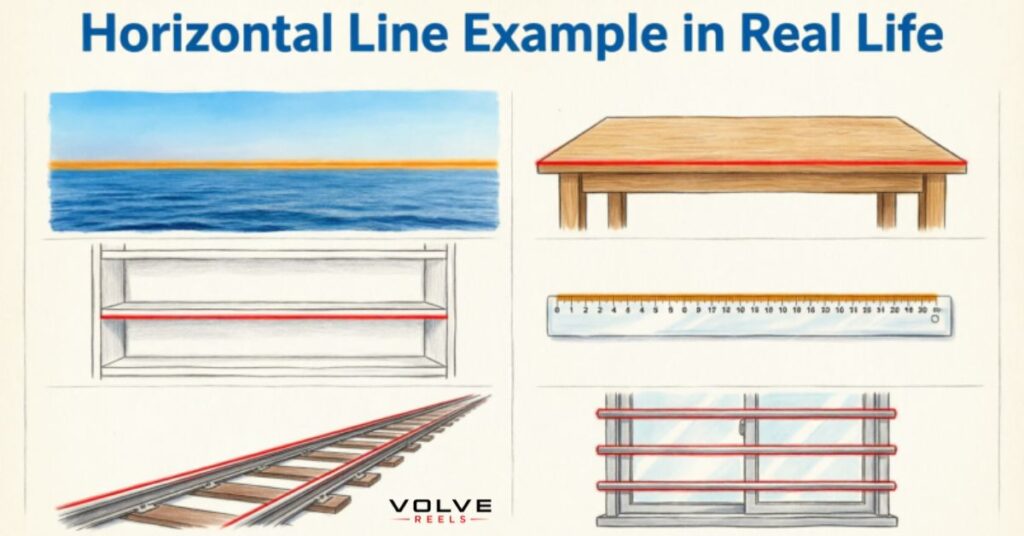
Horizontal lines aren’t limited to math class they appear constantly in the world around us. The flat line where the sky meets the sea, known as the horizon, is one of the clearest natural examples. Tabletops, shelves, windowsills, and the surface of still water all demonstrate horizontal orientation. Even lined notebook paper uses horizontal lines to keep handwriting level. Pointing out these everyday examples helps students connect abstract math vocabulary to objects and scenes they already recognize, making the concept feel far less abstract.
Horizontal in a Sentence
Using horizontal correctly in a sentence reinforces both vocabulary and conceptual understanding. For example: “The gymnast held her arms in a horizontal position, stretched straight out to each side.” Or in a math context: “Draw a horizontal line through the center of the rectangle to divide it into two equal halves.” Practicing sentences like these helps students internalize the word beyond just recognizing lines on a page, strengthening their ability to describe direction and orientation clearly in both writing and conversation.
Frequently Asked Questions
What is the horizontal formula?
A horizontal line is represented by the equation y = c, where c is a constant. This means the y-value stays the same no matter what x equals.
What is an example of horizontal?
A tabletop, the horizon, or a line like y = 3 on a graph are all examples of horizontal orientation, running flat from left to right.
What is parallel and horizontal?
Parallel lines never intersect and maintain equal distance apart, while horizontal specifically describes lines running left to right. Two horizontal lines are always parallel to each other.
Is horizontal left and right?
Yes, horizontal describes movement or position along the left-to-right direction, as opposed to vertical, which runs up and down.
Which direction is horizontal?
Horizontal refers to the flat, sideways direction left to right or right to left parallel to the ground or the x-axis on a graph.
Conclusion
Understanding horizontal direction gives students a foundational tool for describing position, symmetry, and orientation across math and everyday life. From spotting flat lines on a tabletop to reading the x-axis on a coordinate grid, horizontal thinking shows up far more often than most learners realize. Pairing it with vertical direction sharpens spatial reasoning and prepares students for more advanced geometry, graphing, and measurement concepts down the line.
Teaching strategies built around movement, scavenger hunts, and hands-on construction help this idea stick early, while symmetry and reflection tasks deepen the reasoning as students grow. Real-life examples, like the horizon or a shelf, make the abstract feel familiar and concrete. Whether you’re introducing horizontal for the first time or reinforcing it through graphing and geometry, a solid grasp of this direction builds confidence that carries forward into every corner of mathematical thinking.

