
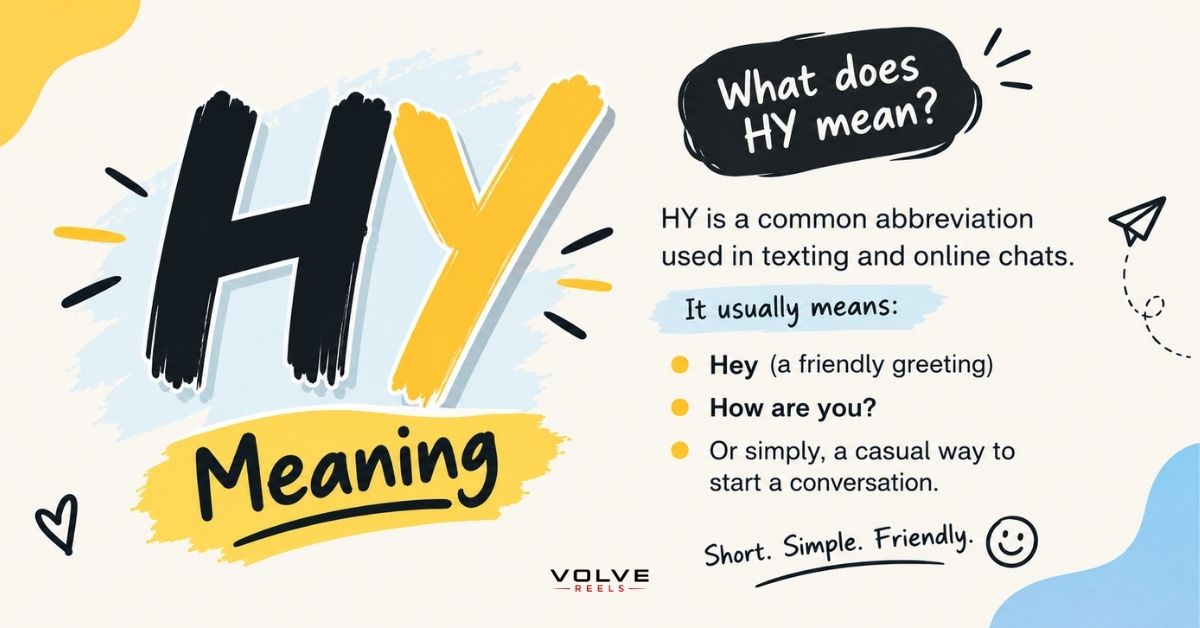

HY Meaning is commonly used in casual digital conversations, especially when people want to communicate quickly. Depending on context, HY can represent “Hell Yes” as an enthusiastic agreement or “Hi You” as a friendly greeting.
Understanding HY Meaning requires attention to the conversation, relationship, platform, and tone. In text messaging, texting, social media, and instant messaging, short expressions often depend on context rather than having one fixed definition.
What is HY?
HY is a short HY acronym used in digital communication and online communication. In everyday texting, it may function as a quick response, an abbreviated greeting, or a form of emotional expression. The surrounding words usually make the intended meaning clearer.
In modern texting language, HY belongs to text messaging slang, texting shorthand, chat acronyms, and digital communication acronyms. It is one of many digital dialogue shortcuts created to make fast-paced digital messaging easier while preserving conversational flow.
The two most relevant interpretations are Hell Yes and Hi You. Hell Yes generally communicates excitement, enthusiasm, agreement, approval, or readiness. Hi You works more like a friendly greeting, particularly when someone wants to open a casual conversation.
There can also be unrelated meanings outside texting. HY may appear in finance, science, and technology, where its meaning depends on the subject. For example, technical discussions can use abbreviations differently from social conversations.
What Does HY Mean?
When asking What Does HY Mean, context is the most important factor. In casual text messaging, HY often means Hell Yes when it appears as an enthusiastic answer. Someone might write “HY! I’m ready” to communicate immediate agreement and energy.
A second interpretation is Hi You, which functions as a casual greeting. Someone beginning a personal conversation with “HY!” may simply be saying hello in a compact way. This Hi You greeting can suggest friendliness, openness, familiarity, and interest in social interaction.
The distinction becomes easier when you consider the surrounding message. A question such as “Are you coming with us?” followed by HY strongly suggests agreement. A message beginning with “HY! How have you been?” is more likely to represent Hi You.
This flexibility explains why HY in Text can have different emotional nuance. The same two letters may communicate excitement in one conversation and a greeting in another.
How HY is Used in Texting?
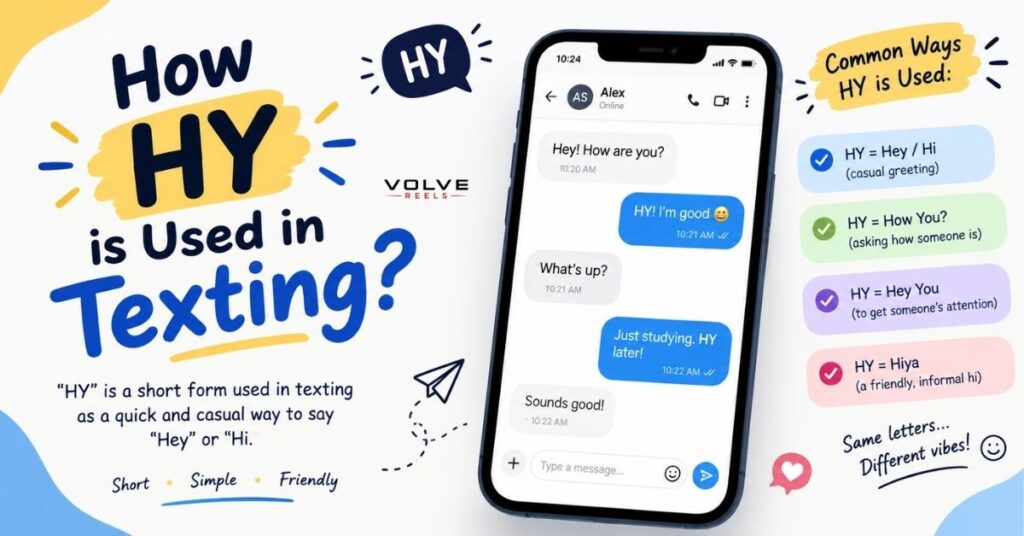
HY usage is strongly connected with text messaging, texting, instant messaging, and social media communication. People often prefer short expressions because digital dialogue moves quickly and users can understand familiar abbreviations without reading lengthy sentences.
In fast-paced digital messaging, HY can provide communication efficiency, brevity, simplicity, and speed. These qualities are important in modern texting language, where communication shortcuts and text abbreviation meanings help people respond without typing every word.
HY in text may appear as a standalone reaction or as part of a longer sentence. Its interpretation depends on the communication context, relationship context, audience, and platform context.
For example:
- “HY! Let’s go!” can communicate excitement.
- “HY! How are you?” can work as a greeting.
- “HY, count me in!” can communicate agreement.
- “HY?” at the beginning of a casual conversation may function as an abbreviated greeting.
1. HY as Hell Yes
HY as Hell Yes is an energetic response. In this form, Hell Yes abbreviation communicates excitement, enthusiasm, approval, agreement, readiness, and a positive reaction.
Imagine a friend asks, “Want to see the new movie tonight?” A reply such as “HY!” communicates immediate agreement without requiring a complete sentence. The expression can also respond to good news, achievements, invitations, celebrations, or trending discussions.
The emotional impact comes from the intensity associated with Hell Yes. It is stronger than a neutral “okay” and usually communicates positive energy. In social media communication, this makes HY useful as a quick social media reaction.
For instance:
- “We finally finished the project!” — “HY!”
- “Want to join the trip?” — “HY! Count me in!”
- “I got the tickets!” — “HY! That’s awesome!”
In each case, HY functions as an enthusiastic reaction rather than a greeting.
2. HY as Hi You
HY as Hi You has a different purpose. Instead of expressing agreement, it works as a friendly greeting. A person may use it when starting personal texting or restarting a conversation with someone they already know.
The Hi You greeting is particularly suited to casual chats because it feels short, familiar, and approachable. It can create connection without the formality of a conventional greeting.
Examples include:
- “HY! How are you?”
- “HY! Long time no talk.”
- “HY! What are you doing?”
- “HY! Hope your day is going well.”
This abbreviated greeting reflects modern communication habits. People increasingly use texting shorthand, chat acronyms, and instant messaging expressions to keep conversations moving.
Why HY is Popular in Texting?
The popularity of HY is connected to communication efficiency. Modern users frequently communicate through phones, instant messaging, and social media, where short responses can save time.
HY also supports emotional expression. A compact abbreviation can communicate excitement, friendliness, acknowledgment, agreement, or approval without requiring a long explanation.
Another reason is conversational flow. In fast-paced digital messaging, people often prefer expressions that can be understood immediately. Text messaging slang and modern texting language provide a shared vocabulary for these quick exchanges.
HY also offers flexibility. It can function as an enthusiastic response, casual response, friendly greeting, professional affirmation in limited situations, or social media reaction. However, the audience and context should always guide its use.
Benefits of Using HY
Instantaneous Communication:
One benefit of HY usage is instantaneous communication. The abbreviation allows people to respond quickly during instant communication without constructing a lengthy sentence.
This supports communication speed and concise communication. In a busy group chat, a short response can acknowledge a message immediately while maintaining conversation flow.
Emotional Expression:
HY can also provide emotional expression and emotional clarity. As Hell Yes, it can show excitement, enthusiasm, joy, approval, and readiness.
As Hi You, it can communicate friendliness, openness, familiarity, and interest. This emotional nuance gives a very short expression more conversational meaning than its length might suggest.
Social Connectivity:
Another benefit is social connectivity. Short expressions can make online interaction feel easier and more immediate.
HY can contribute to relationship building, conversational engagement, social connection, and communication savvy. It is especially useful when participants already understand one another’s conversational language.
Read More: What Does LMS Mean In Slang? Quick Guide
Brevity and Efficiency:
Brevity is another advantage. People communicating through phones often favor simplicity and speed, especially when exchanging several messages.
Short digital dialogue shortcuts can reduce typing while maintaining meaning. This is one reason texting shorthand remains common across online communities.
Instant Communication:
Instant communication also encourages quick reactions. Instead of writing a complete phrase, someone can use HY to acknowledge information or respond with energy.
This is particularly useful in personal texting, group chat messages, and informal social media communication where communication efficiency matters.
Emotional Clarity:
Although short forms can sometimes create ambiguity, HY can provide emotional clarity when the surrounding context is clear. A message such as “HY! I’m ready” leaves little doubt that the sender is enthusiastic.
Conversational Engagement:
A quick reaction can keep a conversation active. HY may invite a follow-up, maintain engagement, and prevent a chat from becoming unnecessarily slow.
Communication Speed:
Digital communication increasingly values speed. Short abbreviations allow users to answer quickly while continuing a conversation across multiple messages.
Simplicity:
HY is simple because it contains only two letters. That simplicity makes it easy to type, remember, and recognize in informal conversations.
Social Connection:
A familiar abbreviation can also reinforce social connection. People who share similar internet slang and texting conventions may find conversations easier and more natural.
The Role of HY in Texting Etiquette
Messaging etiquette matters whenever an abbreviation is used. HY may be perfectly natural in casual chats but unsuitable for formal messaging, depending on the audience and relationship.
Professional messaging deserves particular attention. A professional affirmation should be unmistakably clear, so a full phrase such as “Absolutely” or “Yes, I agree” may be preferable when the recipient could misunderstand HY.
Appropriate usage depends on context, audience, communication context, relationship context, and platform context. Moderation is also important because repeated abbreviations can make a message feel less clear.
Digital communication awareness means understanding that the same expression can sound friendly in one setting and overly informal in another. Good messaging etiquette involves adapting language to the person receiving the message.
Popular Texting Acronyms
HY belongs to a broader collection of texting acronyms and internet slang. Familiar examples include:
| Acronym | Meaning | Typical use |
| LOL | Laugh Out Loud | Amusement |
| OMG | Oh My God | Surprise or strong reaction |
| IDK | I Don’t Know | Uncertainty |
| YOLO | You Only Live Once | Informal expression about taking opportunities |
| HY | Hell Yes / Hi You | Agreement, excitement, or greeting |
These examples demonstrate how digital communication acronyms shorten common expressions. LOL, OMG, IDK, and YOLO have become recognizable forms of text messaging slang, while HY has a more context-dependent meaning.
The wider development of modern texting language reflects communication evolution, language evolution, abbreviated language, language shortcuts, and digital messaging culture. These forms are particularly common in online communities and social media platforms.
Responding to HY
A response to HY should depend on what the sender appears to mean. If HY is being used as Hi You, a friendly response can acknowledge the greeting and continue the conversation.
For example:
“HY! How are you?”
This directly matches the HY greeting and creates a natural opening for social interaction.
If HY means Hell Yes, the response can match the sender’s enthusiasm:
“HY! Let’s do it!”
or:
“HY! Count me in!”
Matching enthusiasm can maintain conversational flow without requiring a long explanation.
When the meaning is unclear, a simple follow-up can provide emotional clarity. Asking what the sender means is better than confidently assuming the wrong interpretation.
The Origins of HY Meaning
There is no single universally established origin for every use of HY. Abbreviations often develop independently within different online communities, messaging groups, and social media environments.
The rise of texting shorthand is closely connected with the growth of instant messaging and fast-paced digital messaging. Users developed shorter expressions because digital communication rewards speed and convenience.
The development of HY therefore fits into broader communication trends. Digital communication acronyms, chat acronyms, text abbreviation, and communication shortcuts have all become part of modern conversational language.
Language evolution also changes how abbreviations are interpreted. As social media trends change, expressions may gain new meanings, become more popular on particular platforms, or develop specialized uses within certain online communities.
HY as Hell Yes: Expressing Excitement
When HY means Hell Yes, it is primarily an enthusiastic response. It can communicate excitement, enthusiasm, agreement, approval, readiness, joy, and celebration.
A person may use Hell Yes after receiving good news, accepting an invitation, supporting an idea, or reacting to an achievement. The expression gives a strong positive reaction without requiring a complete sentence.
For example:
“Want to come to the concert?”
“HY!”
Here, the abbreviation represents immediate agreement and readiness.
In another situation:
“I got the promotion!”
“HY! Congratulations!”
The second response combines excitement with celebration and acknowledgment.
This use illustrates how emotional communication works in digital dialogue. A short expression can carry substantial emotional impact when the audience understands the context.
HY as Hi You: A Casual Greeting
When HY means Hi You, it functions primarily as a greeting. It is appropriate for personal texting, casual chats, social interaction, and conversations between people who are comfortable with abbreviated language.
The expression can communicate friendliness, openness, familiarity, and interest. Because it is short, it can also work as a conversation starter when someone wants to reconnect without sounding formal.
For example:
“HY! What’s new?”
“HY! How has your week been?”
“HY! Are you free later?”
The exact meaning is generally clear from the sentence that follows. A greeting interpretation becomes particularly likely when HY appears at the beginning of a message rather than as an answer to a question.
Snapchat HY: Social Media Use
Social media provides a natural environment for short expressions. Snapchat, Instagram, and Twitter all support rapid interaction, although each platform has its own communication habits.
A Snapchat user might use HY in response to Snapchat stories or Snapchat updates. A person could also send it in Snapchat group chats as a quick reaction to friends.
On Instagram, HY can appear in direct messages, comments, or reactions. Twitter conversations can also contain short reactions when users respond to trending discussions.
These examples illustrate social media language evolution. Social media trends influence how quickly expressions spread, while online communication trends influence how users adapt language for different platforms.
HY in Professional Communication
HY is generally more suitable for informal communication than highly formal professional correspondence. In a workplace chat between familiar colleagues, it might be understood as an enthusiastic response.
For example, a colleague might ask, “Are you available to help with the presentation?” A response such as “HY, happy to help!” clearly conveys enthusiasm.
However, professional messaging should prioritize clarity. A formal email, client communication, official document, or sensitive workplace discussion may benefit from a complete sentence instead.
Professional affirmation should therefore be considered carefully. The relationship, audience, platform, and communication context all influence whether an abbreviation feels appropriate.
Emotional Impact of HY in Texting
HY can create different emotional effects depending on interpretation. Hell Yes usually carries strong positive energy, while Hi You generally creates a friendly and approachable tone.
The emotional expression is not produced by the letters alone. Context, punctuation, surrounding words, and the relationship between participants all contribute to emotional nuance.
For example, “HY!!!” may appear more energetic than “HY.” Similarly, “HY! How are you?” clearly frames the expression as a greeting.
This demonstrates why emotional clarity is important in digital communication. Short forms are efficient, but readers still rely on context to interpret emotional communication accurately.
Comparing HY with Other Acronyms
HY differs from many common acronyms because it has multiple common interpretations. LOL usually refers to laughter, IDK usually indicates uncertainty, and OMG commonly communicates surprise or strong emotion.
HY can instead function as either an enthusiastic response or a greeting. This gives it flexibility but can also create ambiguity for readers who are unfamiliar with the expression.
| Expression | Common interpretation | Main function |
| HY | Hell Yes / Hi You | Agreement or greeting |
| LOL | Laugh Out Loud | Laughter |
| OMG | Oh My God | Surprise or emotion |
| IDK | I Don’t Know | Uncertainty |
| YOLO | You Only Live Once | Informal life-related expression |
The comparison shows how text abbreviation meanings depend on shared knowledge. Familiarity with internet slang can make communication faster, while unfamiliar abbreviations may require clarification.
Best Practices for Using HY
Use HY when the communication setting is informal enough for abbreviated language. Personal texting, casual chats, group messages, and friendly social media conversations are the most natural environments.
Before using it, consider the audience. Someone who rarely uses texting acronyms may not immediately understand it. Clear surrounding language can solve much of this problem.
Consider the meaning as well. If HY is intended as Hell Yes, make the enthusiastic context visible. If it means Hi You, follow it with a recognizable greeting or question.
Moderation is another useful principle. Even when an abbreviation is appropriate, overuse can reduce emotional impact and make a conversation feel repetitive.
Good messaging etiquette therefore combines brevity with clarity. Effective digital communication does not simply mean using the shortest possible expression; it means choosing language that the recipient can understand easily.
Hy meaning in chat
In chat, HY usually depends on the surrounding message. It may mean Hell Yes when it answers a question positively, or Hi You when it starts a conversation.
Chat acronyms are designed for quick exchanges, so context is especially important in instant messaging. A sender can make the intended meaning clearer by adding a few words after HY.
For example, “HY! I’m coming” suggests agreement, while “HY! How are you?” strongly suggests a greeting.
The same principle applies to social media communication and personal texting. The recipient should consider the entire message rather than interpreting HY in isolation.
HY meaning in Text from girl
If a girl sends HY, the abbreviation does not automatically indicate a special romantic meaning. The interpretation should come from the surrounding conversation, the relationship, and the wording that follows.
HY could simply mean Hi You as a friendly greeting. It could also mean Hell Yes if she is enthusiastically agreeing with something.
Avoid assuming that the sender’s gender changes the dictionary meaning. Digital communication awareness means focusing on communication context rather than assigning an unsupported hidden meaning.
For example, “HY! How are you?” is naturally a greeting, while “HY! Let’s go!” is more naturally an enthusiastic response.
Hy meaning in whatsapp
On WhatsApp, HY can be used in personal texting, group chat messages, and informal conversations. The application itself does not give HY one official definition.
WhatsApp users may interpret HY as Hell Yes or Hi You based on context. The relationship between participants can also influence how the abbreviation feels.
Because WhatsApp supports both personal and professional messaging, audience awareness is useful. A close friend may understand HY immediately, while a business contact might prefer a complete phrase.
Hy meaning snapchat
On Snapchat, HY can appear in direct messages, Snapchat stories, Snapchat updates, and Snapchat group chats. Its meaning remains context-dependent.
Snapchat HY meaning can therefore represent either a greeting or an enthusiastic reaction. A response to exciting content may suggest Hell Yes, while an opening message may suggest Hi You.
This illustrates how social media platforms influence modern texting language. Users often adapt their language to quick interactions and changing social media trends.
Hy meaning in text from a guy
When a guy sends HY, the meaning should be interpreted from the actual conversation rather than assumed from gender. HY can simply function as a friendly greeting or enthusiastic response.
If the message begins with “HY! How are you?”, it is likely being used as a Hi You greeting. If it responds to a question such as “Are you coming?”, it may represent Hell Yes.
Relationship context, communication context, and the surrounding words are more useful than guessing an unstated intention.
HY meaning in instagram
On Instagram, HY may occur in direct messages, comments, reactions, or casual conversations. The platform does not establish a single universal interpretation.
Instagram users may use HY as a social media reaction to an exciting post or as an abbreviated greeting in a private conversation.
The meaning can be clarified by the words around it. “HY! That looks amazing” communicates enthusiasm, while “HY! What’s up?” functions more like a greeting.
HY HY meaning in text
When someone writes HY HY, repetition can change the tone even though the basic abbreviation remains context-dependent. Repeating a short expression may add energy, friendliness, urgency, or playful emphasis.
If the sender is responding to exciting news, HY HY may intensify the enthusiastic reaction. If the conversation is beginning, repetition can make the greeting feel more playful.
The best interpretation still comes from the surrounding message, punctuation, and relationship between participants.
Hy meaning in medical
In medical contexts, HY should not automatically be interpreted as texting slang. Medical terminology contains many abbreviations, and their meanings can vary by specialty, institution, or document.
A reader should therefore use the full medical context before deciding what HY represents. It may have a technical meaning unrelated to Hell Yes or Hi You.
When accuracy matters, especially in medical communication, an unexplained abbreviation should be clarified rather than guessed. This is an important distinction between informal digital dialogue and formal technical communication.
FAQs
What does hy mean in text?
In text, HY commonly means Hell Yes or Hi You. Hell Yes expresses enthusiasm, agreement, approval, or readiness, while Hi You functions as a casual greeting. The surrounding words usually reveal which interpretation is intended.
What is the full form of hy?
The two common texting expansions are Hell Yes and Hi You. Hell Yes is generally an enthusiastic response, while Hi You is a short greeting. Other fields may use HY differently, so technical context should always be considered.
What is hy on TikTok?
On TikTok, HY can be interpreted according to the surrounding conversation or comment. It may represent Hell Yes as an enthusiastic reaction or Hi You as a casual greeting. TikTok does not make one interpretation universally applicable.
What is hy in English?
In English texting, HY is an informal abbreviation rather than a standard standalone English word. It can represent Hell Yes or Hi You in casual digital communication, depending on context.
What do we mean by hy?
We generally mean a short abbreviation used in informal communication. In texting, it most commonly refers to Hell Yes or Hi You, but the correct interpretation depends on the conversation, audience, and communication setting.
Conclusion
HY is a compact expression that can support quick digital communication while carrying different meanings. Hell Yes communicates excitement, agreement, approval, or readiness, whereas Hi You works as a friendly greeting. Context remains the key to understanding the intended message.
Using HY effectively requires awareness of audience, relationship, platform, and tone. In casual texting and social media communication, it can make exchanges brief and energetic, while formal or technical communication may require clearer wording.

