
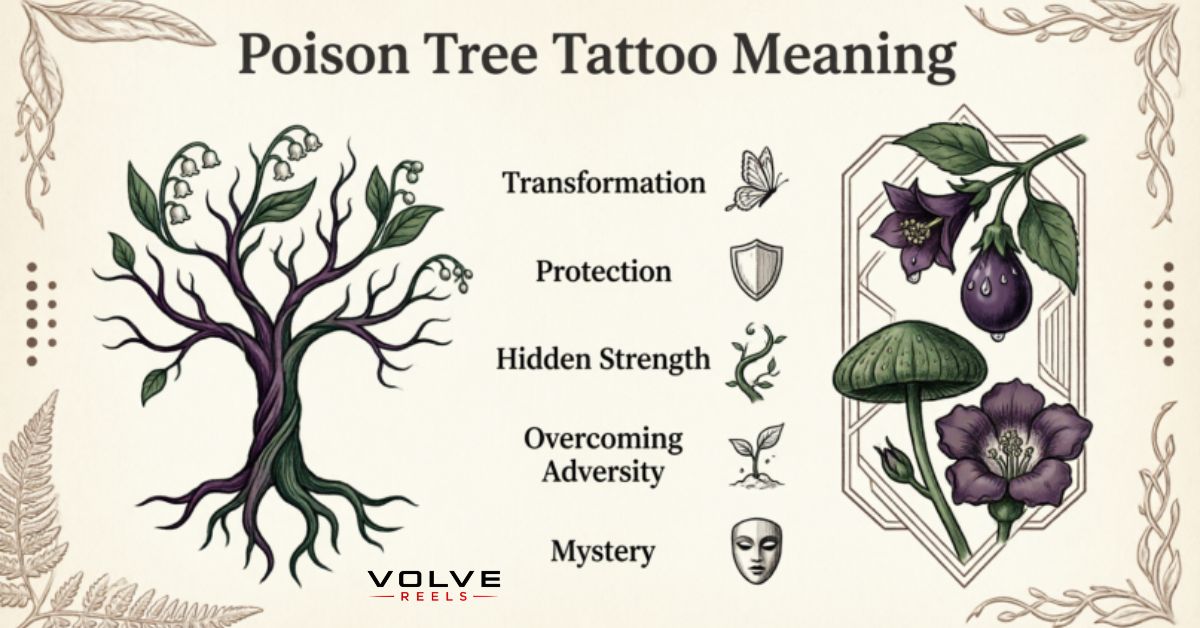

A Poison Tree tattoo can look mysterious, beautiful, and unsettling at the same time. Its dark tree, roots, branches, and often a single striking apple create an image that feels deeper than an ordinary botanical tattoo.
The Poison Tree Tattoo Meaning is closely connected with emotion, silence, resentment, temptation, and consequences. The idea comes from William Blake’s poem “A Poison Tree,” published in Songs of Experience in 1794, where anger that remains unspoken grows into a poisonous tree. For some wearers, the image represents suppressed anger or hidden resentment. For others, it becomes a reminder about emotional honesty, healing, survival, and choosing healthier ways to process difficult feelings.
What Does a Poison Tree Tattoo Mean?
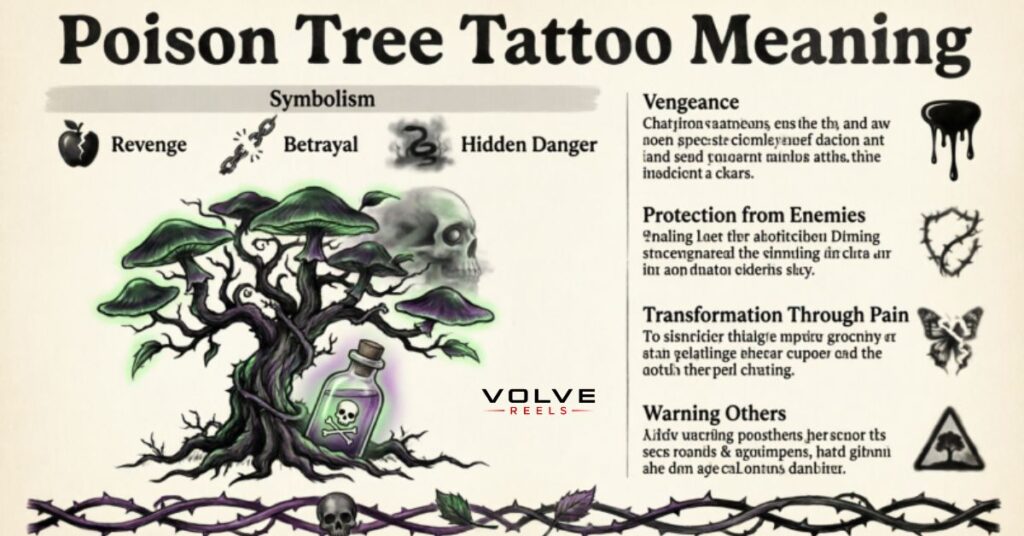
The central Poison Tree Tattoo Meaning is the transformation of an emotion into something that grows when it remains hidden. A Poison Tree can therefore represent suppressed anger, hidden resentment, unexpressed emotions, and the consequences of silence.
The tree becomes a psychological metaphor. Its roots can suggest deep-seated emotions, its trunk can represent an internal struggle, and its branches can show how toxic emotions spread through a person’s life. A poisonous apple can then symbolize the visible consequence of an emotion that was allowed to mature.
This does not mean every Poison Tree Tattoo represents hatred or revenge. A Symbolic Tattoo can also represent self-awareness. Someone may use the image as a Reminder that emotional suppression has consequences and that speaking your truth can prevent bitterness from taking root.
The Poison Tree Tattoo Meaning can also change with personal experience. Someone recovering from betrayal may see the tree as a symbol of survival, while someone leaving a toxic relationship may see it as reclaimed power. A person experiencing grief may interpret the same dark tree as emotional pain gradually becoming healing.
In that sense, the Poison Tree Symbol is less about being an angry person and more about recognizing what anger, resentment, and silence can do when they are ignored.
Where Does the Poison Tree Symbol Come From?
The Poison Tree Symbol comes most directly from William Blake and his poem A Poison Tree. The poem appeared in Songs of Experience in 1794 and uses a growing tree to turn an emotional conflict into a memorable image.
William Blake contrasts a Friend with a Foe. The speaker admits anger to a friend and the anger disappears, while anger toward an enemy is hidden. That hidden feeling is fed until it develops into a tree bearing a Shining apple.
The story is deliberately uncomfortable. The apple is attractive, yet it carries Death. The image creates a connection between beauty and danger, temptation and consequence, and emotional suppression and destructive action.
Blake’s poetry frequently uses symbolic images rather than straightforward explanations. In this poem, the tree functions as an Allegory for resentment. The Speaker becomes both the person experiencing anger and the person responsible for nurturing it.
That distinction is important when considering Poison Tree Symbolism. The tree does not simply mean evil. It shows how a feeling can change when someone refuses to confront it.
The poem’s Four stanzas and Sixteen lines make the narrative compact, but its psychological depth gives the Poison Tree Imagery lasting relevancez
The William Blake Poem: A Quick Breakdown
The Poison Tree poem can be understood through four major stages:
- The Speaker acknowledges anger toward a Friend, allowing the conflict to end rather than feeding it.
- Anger toward a Foe remains unspoken and becomes connected with tears, false behavior, and emotional silence.
- The emotion grows into a Poison Tree and produces a Shining apple.
- The Enemy takes the fruit, suffers Death, and the ending exposes the danger of nurturing hatred.
The important idea is not simply that anger becomes a tree. It is that emotional avoidance can become a pattern. Suppressed anger becomes Hidden resentment, and Hidden resentment can develop into Bitterness.
The apple adds another layer. A Bright apple can look harmless or desirable while representing a destructive outcome. This makes the Poisonous apple a powerful tattoo element because it can communicate hidden danger without requiring a literal depiction of violence.
Blake’s imagery also creates a contrast between appearance and reality. A dark tree may look beautiful in a tattoo, while the story behind it can concern Emotional destruction, revenge, betrayal, or unresolved feelings.
That is why a Literary Tattoo based on Blake’s poetry can feel psychologically different from a decorative Tree Tattoo. The image has a narrative behind it.
Poison Tree meaning
The Poison Tree meaning can be interpreted as a warning about what happens when difficult emotions are repeatedly denied. The tree grows because the emotion receives attention, even when that attention is expressed through secrecy, resentment, or avoidance.
For one person, the Poison Tree meaning may be about anger. For another, it may represent grief, betrayal, emotional wounds, or a period of Internal struggle. The important factor is the wearer’s lived experience.
A meaningful interpretation can also be positive. The tree can symbolize recognizing toxic thought patterns before they become destructive. In that reading, the tattoo represents Emotional awareness rather than emotional destruction.
A dark tree can therefore become a reminder to practice Emotional honesty, Confronting emotions, and Processing emotions instead of relying on Emotional avoidance. The symbolism changes from “I am consumed by anger” to “I understand what anger can become.”
Biblical and Historical Roots of the Poison Tree
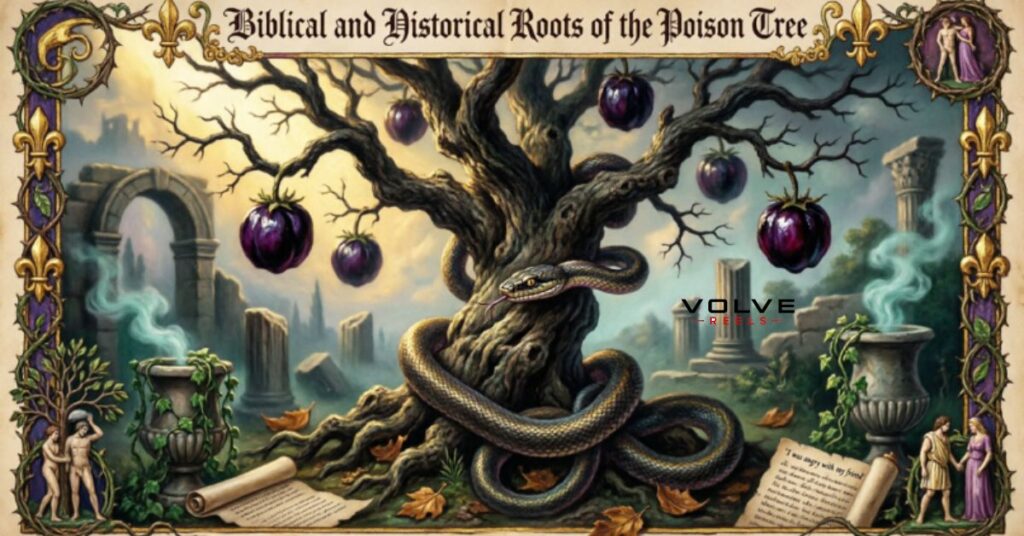
The Poison Tree does not exist in complete isolation from older cultural imagery. Trees, fruit, serpents, temptation, death, and moral decay have appeared together in Biblical tradition and other forms of historical symbolism.
The Garden of Eden is an especially obvious comparison. The Tree of Knowledge and Forbidden fruit are associated with temptation, deception, the Fall from grace, exile, suffering, and Death. A tattoo combining an apple with a dark tree may therefore carry Biblical symbolism even when its primary inspiration is William Blake.
The Snake or Serpent can strengthen this association. A serpent wrapped around a trunk can suggest temptation, betrayal, secret sin, or the tension between beauty and danger.
Norse mythology provides another useful comparison through Yggdrasil, the World Tree. Yggdrasil is not a Poison Tree, but its roots and Serpents create imagery involving hidden forces beneath the surface. This makes roots and corruption visually useful when designing a dark symbolic tree.
Ancient Persian literature and Renaissance art also contain traditions in which poisoned trees, corrupted fruit, betrayal, and moral decay can operate as symbolic imagery. These traditions should not be treated as identical to Blake’s poem, but they help explain why tree imagery can carry such psychological and moral weight.
The result is a broader Cultural symbolism in which a tree can represent growth while poisonous fruit represents corruption. That contradiction is one reason the Poison Tree Tattoo Meaning remains so compelling.
What Emotions Does a Poison Tree Tattoo Represent?
The emotional Poison Tree Tattoo Meaning can vary considerably. Common interpretations include:
- Suppressed anger
- Hidden resentment
- Unexpressed emotions
- Bottled-up emotions
- Emotional suppression
- Emotional repression
- Bitterness
- Hatred
- Revenge
- Toxic emotions
- Toxic feelings
- Emotional pain
- Inner conflict
- Internal struggle
- Emotional burden
- Hidden emotions
- Secret emotions
- Unresolved feelings
- Unresolved anger
- Long-held resentment
- Emotional wounds
- Inner wounds
- Emotional damage
- Grief
- Sadness
- Mourning
- Betrayal
- Loss
- Fear
- Silence
- Frustration
- Emotional vulnerability
- Emotional exhaustion
For someone with a history of a Toxic relationship, the tree can represent the emotional weight created by constantly keeping feelings inside. For someone who experienced betrayal, the roots may symbolize the way broken trust can remain long after an event has ended.
A person dealing with grief may choose falling leaves instead of a poisonous apple. In that case, the tree can represent Mourning, acceptance, and Letting go.
Someone recovering from Emotional abuse may use the image as a marker of survival. The tattoo does not have to celebrate anger. It can acknowledge the existence of pain while representing Recovery, resilience, and Personal growth.
This is where Emotional symbolism becomes especially useful. A tattoo can hold several meanings simultaneously: pain and hope, darkness and healing, anger and forgiveness, memory and release.
Poison Tree Tattoo Designs: What the Visual Elements Mean
A Poison Tree Design becomes more meaningful when its visual elements have a deliberate purpose.
| Design element | Possible symbolism |
| Dead branches | Emotional exhaustion |
| Bare branches | Suppressed emotions |
| Deep roots | Deep-seated emotions |
| Spreading roots | Long-held anger |
| Cracked trunk | Internal damage |
| Split trunk | Emotional fracture |
| Dark branches | Hidden emotions |
| Poisonous apple | Destructive consequences |
| Bright apple | Deceptive beauty |
| Glowing apple | Temptation and danger |
| Forbidden fruit | Biblical temptation |
| Thorns | Concealed pain |
| Full moon | Darkness and secrecy |
| Snake | Betrayal or temptation |
| Serpent | Biblical symbolism |
| Falling leaves | Letting go |
| Ravens | Darkness |
| Crows | Wisdom |
| Hourglass | Passage of time |
| Broken lock | Emotional release |
| Roses | Beauty and pain |
A Dark Tree Tattoo with Dead branches can communicate emotional exhaustion. A Dark Botanical Tattoo with intricate roots can emphasize hidden emotional depth. A Poison Tree Tattoo Design with one glowing apple can create a strong contrast between deceptive beauty and destructive temptation.
Roots are particularly important because they suggest what cannot immediately be seen. Deep roots can symbolize Internalized anger, hidden wounds, unresolved feelings, and an Emotional burden that has existed for a long time.
A Cracked trunk can represent Psychological damage or a Split trunk can represent Emotional fracture. Thorns can suggest suffering that remains concealed beneath a calm exterior.
A Full moon can introduce secrecy and nighttime symbolism. A Snake or Serpent can shift the design toward betrayal, deception, temptation, and Biblical imagery.
Falling leaves can completely change the emotional direction. Instead of emphasizing Revenge or Hatred, they can represent Release, recovery, and letting go.
Read More: IGH Meaning in Text: Full Guide With Real Examples
Medusa tattoo meaning
Medusa tattoo meaning is often associated with protection, transformation, survival, power, and reclaiming control after betrayal or harm. Like a Poison Tree Design, Medusa imagery can carry a darker emotional history without having only one interpretation.
The comparison is useful because both symbols can communicate complicated experiences through visual storytelling. A Medusa tattoo may represent Reclaimed power, while a Poison Tree Symbol can represent the recognition of suppressed anger and the decision to stop nurturing it.
Medusa tattoo meaning can also involve turning vulnerability into strength. This makes Medusa imagery relevant to people interested in Psychological Tattoo concepts, Gothic Tattoo aesthetics, and symbolic representations of survival.
Read More: IGH Meaning in Text: Full Guide With Real Examples
Who Gets Poison Tree Tattoos and Why?

A Poison Tree Tattoo can appeal to many different groups because its symbolism is broad.
People who may connect with the design include:
- Survivors of emotionally abusive relationships
- People recovering from Toxic relationships
- People who have experienced betrayal
- Writers and poets
- Artists and creatives
- Literature lovers
- William Blake readers
- People experiencing grief
- People with suppressed anger
- People processing emotional pain
- People interested in gothic tattoos
- People interested in dark botanical tattoos
- Tattoo enthusiasts interested in symbolism
- People using body art as healing
- People interested in psychological symbolism
For writers and poets, the Literary symbolism can be especially meaningful. A William Blake Tattoo can function as a personal connection to Poetry and Blake’s imagery.
For someone recovering from a difficult relationship, the tree can represent a chapter of life that produced emotional wounds but ultimately led to Self-awareness and Personal transformation.
For another person, the design may simply represent the tension between Nature symbolism and Dark aesthetics. A tattoo does not need to correspond to a single life event.
Poison Tree Tattoo vs. Other Dark Tree Tattoos: Key Differences
| Tattoo type | Core interpretation | Common visual direction |
| Poison Tree | Suppressed anger and emotional consequences | Dark tree with poisonous or bright fruit |
| Dead Tree Tattoo | Loss, grief, or an ending | Bare trunk and branches |
| Tree of Life Tattoo | Growth, family, connection, resilience | Balanced roots and canopy |
| Weeping Willow Tattoo | Sadness, mourning, vulnerability | Drooping branches |
| Twisted Tree Tattoo | Inner struggle and complexity | Gnarled trunk |
| Tree With Serpent Tattoo | Temptation or betrayal | Snake around branches or trunk |
| Dark Tree Tattoo | Mystery, darkness, or personal symbolism | Shadowed tree |
| Gothic Tree Tattoo | Gothic aesthetics and mortality | Black ink, shadows, moonlight |
| Botanical Tattoo | Nature and organic beauty | Detailed leaves and stems |
| Fine Line Tree Tattoo | Minimal symbolic expression | Delicate line work |
The Poison Tree Symbol is distinct because it links internal emotion with consequences. A Dead Tree Tattoo may emphasize Loss, while a Tree of Life Tattoo commonly emphasizes Growth and Connection.
A Weeping Willow Tattoo can communicate Sadness or Mourning, whereas a Twisted Tree Tattoo can focus on complexity and resilience.
A Tree With Serpent Tattoo may emphasize temptation or Biblical themes. The Poison Tree Tattoo Meaning becomes more specific when an apple is included because the fruit directly recalls Blake’s poem.
Placement Ideas and What They Add to the Meaning
Tattoo placement can influence how private or visible the symbolism feels.
A Forearm tattoo or Wrist tattoo is easy to see and can function as a daily Reminder. An Inner wrist tattoo may feel particularly personal because it can be viewed frequently without being highly visible to everyone.
A Ribcage tattoo or Sternum tattoo is more private. These locations can suit someone who wants the Emotional symbolism to remain close to the body and away from casual attention.
A Back tattoo or Spine tattoo can emphasize the idea of carrying an Emotional burden. The vertical shape of the spine can also provide room for detailed branches, roots, and literary imagery.
A Thigh tattoo or Calf tattoo offers greater privacy while allowing enough space for detailed roots and branches. A Shoulder tattoo or Upper arm tattoo can balance visibility with personal control.
Placement should also follow the composition of the tattoo. A wide root system may work better on a larger surface, while a Fine Line Tree Tattoo can be adapted to smaller areas.
Common Mistakes People Make With This Tattoo
A common mistake is choosing a Poison Tree Tattoo Design only because the Dark botanical imagery looks attractive. The imagery is beautiful, but the symbolism can be surprisingly serious.
Another mistake is making the design so literal that it loses visual clarity. A tattoo does not need to illustrate every moment of A Poison Tree. A tree, apple, roots, and carefully selected details can communicate more than an overcrowded scene.
Choosing the wrong Tattoo artist can also affect the result. Detailed roots, Fine line work, Gothic elements, and botanical details require strong technical control.
Another mistake is overlooking composition. If the apple is supposed to be the focal point, the branches should guide attention toward it. If the roots represent the main emotional idea, they should receive enough space to remain visible over time.
Some people also forget that Black ink and Dark imagery need contrast. A design that is entirely black can lose its smaller details as the tattoo ages.
Finally, rushing Tattoo placement can make a meaningful tattoo feel less personal. Consider whether you want a visible tattoo that works as a daily Reminder or a Hidden tattoo reserved for private reflection.
Does the Poison Tree Tattoo Have a Positive Meaning?
Yes. The Poison Tree Tattoo Meaning can be positive when the wearer treats the image as a warning, a record of survival, or a reminder to practice Emotional honesty.
A tattoo can acknowledge bitterness without celebrating it. It can say, “I know what happens when I suppress my emotions, and I choose a different path.”
Positive interpretations can include:
- Self-awareness
- Emotional intelligence
- Personal growth
- Healing
- Recovery
- Letting go
- Emotional release
- Speaking your truth
- Healthy expression
- Acceptance
- Forgiveness
- Resilience
- Survival
- Reclaimed power
- Personal transformation
- Self-discovery
- Emotional freedom
This is an important distinction. The poem presents a Moral warning, but the tattoo wearer can turn that warning into a personal Reminder.
The Poison Tree Tattoo Meaning can therefore become a commitment to Confronting emotions instead of avoiding them. It can symbolize Processing emotions rather than Bottling-up emotions.
For someone who has overcome a Toxic relationship, the tree may represent survival. For someone who has moved beyond resentment, it can symbolize letting go. For someone rebuilding after betrayal, it can represent resilience.
Poison Tree poem

The Poison Tree poem is a short literary work by William Blake that explores anger, communication, resentment, and destructive consequences. Published in Songs of Experience in 1794, it uses a tree and apple as an extended metaphor for emotional growth.
The Poison Tree poem is especially important to tattoo symbolism because its central image is easy to adapt visually. Roots can represent the beginning of resentment, branches can show its spread, and fruit can represent its eventual consequence.
The poem also contrasts emotional expression with emotional silence. Anger that is communicated can disappear, while anger that remains hidden can become stronger.
That makes the poem relevant to modern conversations about Emotional awareness, Emotional intelligence, Emotional suppression, and healthy Emotional expression.
Related Keywords Worth Knowing
Several related tattoo concepts can help someone refine the Poison Tree Tattoo Meaning they want.
A William Blake Tattoo may use other images from Blake’s poetry and artwork. A Literary Tattoo can connect a design to a specific text, while a Psychological Tattoo can emphasize an internal experience.
A Dark Botanical Tattoo generally combines plant imagery with darker aesthetics, while a Gothic Tree Tattoo may use moonlight, shadows, ravens, skulls, or other Gothic elements.
A Symbolic Tree Tattoo can be broader than a Poison Tree Symbol because the tree may represent Family, Growth, Connection, grief, survival, or Nature symbolism.
Useful search concepts include:
- poison tree tattoo ideas
- William Blake poison tree tattoo
- A Poison Tree tattoo meaning
- William Blake tattoo meaning
- poison tree symbol meaning
- poison tree symbolism
- dark tree tattoo meaning
- poisonous apple tattoo meaning
- apple tree tattoo meaning
- forbidden fruit tattoo meaning
- tree tattoo symbolism
- dark botanical tattoo meaning
- gothic tree tattoo meaning
- tattoo for suppressed anger
- tattoo for resentment
- tattoo representing anger
- tattoo representing emotional pain
- tattoo representing toxic relationships
- tattoo representing betrayal
- tattoo representing healing
- tattoo representing survival
- tattoo representing emotional growth
- tattoo representing letting go
- tattoo representing hidden emotions
- tattoo about emotional suppression
- tattoo about bottled-up emotions
- tattoo about grief
- tattoo about inner struggle
- literary tattoo ideas
- William Blake tattoo ideas
For design research, people may also explore Poison Tree tattoo placement, Poison Tree tattoo sleeve, Poison Tree forearm tattoo, Poison Tree back tattoo, Poison Tree rib tattoo, Poison Tree sternum tattoo, Poison Tree thigh tattoo, and Poison Tree spine tattoo.
Style searches can include Poison Tree fine line tattoo, Poison Tree gothic tattoo, Poison Tree blackwork tattoo, Poison Tree with apple tattoo, Poison Tree with snake tattoo, Poison Tree with thorns tattoo, Poison Tree with moon tattoo, Poison Tree roots tattoo, Poison Tree and raven tattoo, Poison Tree and crow tattoo, Poison Tree and hourglass tattoo, and Poison Tree and broken lock tattoo.
Semicolon tattoo meaning
Semicolon tattoo meaning is commonly associated with continuation, choice, resilience, and the idea that a difficult chapter does not have to be the end of a person’s story. Its punctuation-based symbolism differs from the Poison Tree Symbol, but both can function as personal reminders.
Semicolon tattoo meaning can therefore complement a broader tattoo narrative about survival, Recovery, Self-awareness, and Personal transformation. A person might choose one symbol for the experience and another for the decision to continue.
The important difference is that a semicolon is usually a direct symbol of continuation, while the Poison Tree Tattoo Meaning is more concerned with emotional suppression, consequences, resentment, and the possibility of releasing what has been carried.
FAQ’s
Why do people get poison tree tattoos?
People get poison tree tattoos for many reasons, including suppressed anger, betrayal, grief, toxic relationships, emotional pain, literature, and personal growth. For some, the image represents a difficult period they survived. For others, it is a Reminder to avoid Emotional suppression and to practice Emotional honesty.
What does the poison tree symbolize?
The poison tree commonly symbolizes Suppressed anger, Hidden resentment, Unexpressed emotions, Bitterness, Revenge, and the consequences of nurturing Toxic emotions. The Roots can represent deep-seated emotions, while the apple can represent temptation or destructive consequences.
However, the symbolism does not have to remain negative. The tree can also represent Self-awareness, Healing, Recovery, Resilience, and Letting go when the wearer treats it as a warning about what emotional suppression can create.
Which tattoo to avoid?
There is no universally “bad” tattoo, but you should avoid any design you do not understand or that you may later regret. With a Poison Tree Tattoo Design, rushing into an elaborate design without understanding its Literary symbolism can create a mismatch between appearance and intention.
It is also sensible to avoid choosing a Tattoo artist without reviewing relevant work. Detailed branches, Intricate roots, Fine line work, Gothic elements, and Botanical details require appropriate technical skill.
What is the meaning behind the poison tree?
The meaning behind the poison tree comes primarily from William Blake’s A Poison Tree. The tree represents anger that is hidden rather than communicated, while the fruit represents the destructive result of allowing that emotion to grow.
The deeper Poison Tree Tattoo Meaning can involve emotional suppression, Resentment, Hidden emotions, Psychological hold, Emotional burden, and the consequences of silence. In a modern personal interpretation, the tattoo can become a warning to process emotions before they become destructive.
What is the message of the Poison Tree?
The central message of the Poison Tree is that hidden anger can grow when it is deliberately nurtured. Blake’s poem contrasts speaking openly with keeping resentment secret, creating a Cautionary tale about emotional silence and its consequences.
For tattoo wearers, that message can become constructive. The image can represent Emotional awareness, Speaking your truth, Healthy expression, Self-reflection, and choosing not to let Long-held resentment control the future.
Final Thought
The Poison Tree Tattoo Meaning is ultimately about more than darkness, fruit, branches, or Gothic aesthetics. It can represent the complicated relationship between anger, silence, resentment, emotional pain, and personal choice. For many wearers, the tree becomes a visible Reminder of something they survived or something they refuse to repeat.
Whether the design includes a Bright apple, Deep roots, Dead branches, a Snake, Full moon, Thorns, or Falling leaves, the symbolism can be deeply personal. A well-designed Poison Tree Tattoo can acknowledge difficult emotions while also representing Healing, Resilience, Reclaimed power, and Personal growth.
The strongest designs do not simply make darkness look attractive. They use Dark botanical imagery to tell a story about emotional experience, self-reflection, and transformation. That is what gives the Poison Tree Symbol its psychological depth.
Conclusion
The Poison Tree Tattoo Meaning can also be connected with William Blake and A Poison Tree. Writers, poets, artists, and Literature lovers may choose the design because the image combines literary symbolism with Dark botanical aesthetics.

